
Restorationism Receipts
What the First-Century House Churches Actually Looked Like (And Why Restorationists Aren't Crazy)

If the last two articles left you steaming at the institutional marketing department that rebranded the apostles’ own relatives as “heterodox” and turned their low-profile house churches into footnotes, buckle up. This is the part where we open the filing cabinet, dump every receipt on the table, and show you exactly what those first-century congregations looked like—from the inside out.
Not the polished basilica version the corporate sponsors sold after 325 AD (as we exposed in “325 AD: The Year Theology Got a Corporate Sponsor” and “Constantine’s Con Job”). Not the sanitized “Jewish phase ended on schedule” narrative that turned apostolic amity into papal animus (see “From Apostolic Amity to Papal Animus: Unmasking the Myth of Early Christian Jew-Hatred”). And definitely not the version that pretends the original model disappeared while Rome was busy bullying other apostolic remnants into line (remember “The Florence Fiasco: Rome’s Botched Bullying of Ethiopia’s Apostolic Remnant”).
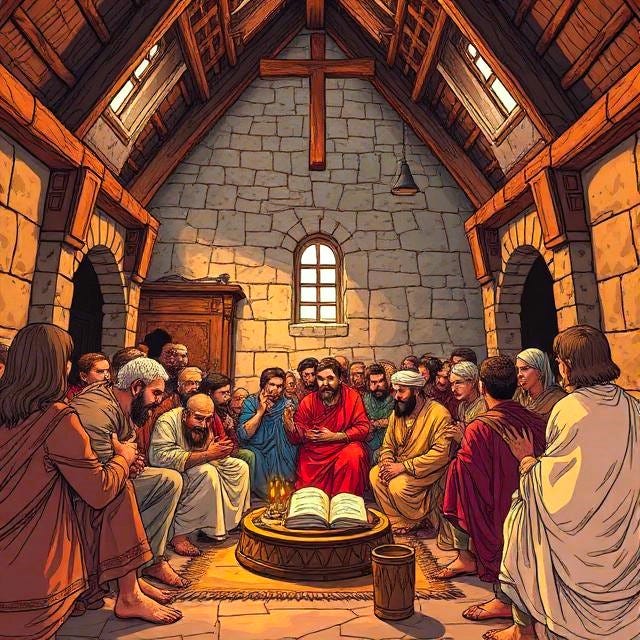
This is the raw, un-upgraded product: Torah-observant without hypocrisy, Logos-as-flesh without Plato’s philosophy degree, festivals kept in humble house-synagogue gatherings, led by Desposyni families and ethnic-Israel networks across Galilee, Pella, Bashan near Mount Hermon, Coelesyria, the Decapolis, Jordan fringes, and even northern Egypt edges. And the proof isn’t some lost gospel fragment or conspiracy theory. It’s right there in the sources the machine hoped you’d never read in full. Restorationists aren’t crazy for wanting this back. They’re just late to the family reunion. The receipts prove the model never actually closed shop—it just got parked in the “legacy” garage with a “Caution: Too Jewish” sticker. Let’s pull it out, dust it off, and see why it still runs perfectly.
We begin where the apostles left it: Jerusalem, pre-70, then the Pella flight. Acts 15 is the constitutional document. James the Just (Jesus’ own brother) presides. The verdict? Gentiles don’t have to become Jews, but the core Jewish believers—ethnic Israel, disciple-led, Desposyni-influenced—keep right on observing the full Torah as fulfilled in Messiah. No animal rerun required (Hebrews 10:1-18 makes that plain), but Sabbath, kosher, festivals, circumcision for the Jewish core—all still in force “without hypocrisy.” Eusebius (History of the Church 3.5) confirms the entire Jerusalem congregation fled to Pella on Christ’s warning before Titus arrived. That’s not legend; it’s the launch point for the house-church network that spread exactly where Epiphanius later mapped it: Beroea in Coelesyria, the Decapolis near Pella, Bashanitis at Cocabe/Kokhaba in Hebrew (Onomasticon and Panarion 29). These weren’t mega-churches. They were homes turned synagogues—small, intimate, family-run fellowships where the Desposyni (the “Lord’s kin,” per Bauckham’s exhaustive study in Jude and the Relatives of Jesus) carried the bloodline and the memory. Richard Bauckham shows them traveling from Nazareth and Kokhaba with preserved Davidic genealogies (despite Herod’s burnings), presenting themselves as living witnesses into Trajan’s reign. They weren’t claiming thrones; they were keeping the receipts.
Now the distinctives—the parts the Hellenized upgrade tried to Photoshop out.
First, their Christology: Logos Monarchian, straight from John 1 in its original Jewish Wisdom/Targum soil, not the Platonic committee meeting that got corporate sponsorship at Nicaea (as we detailed in “325 AD: The Year Theology Got a Corporate Sponsor”). Epiphanius himself—grudgingly—records it: they “confess that Christ Jesus is Son of God… born of Mary by the Holy Spirit.” Virgin birth intact, miracles, resurrection, but the Word is begotten as flesh (John 1:14), God’s creative reason made visible, not a co-equal second person invented to impress Greek philosophers. No modalism, no adoptionism like the later Ebionite splinter, but a clean Jewish monotheism with Messiah at the center. This matches the Pines/Abd al-Jabbar manuscript’s fifth-century Nazarene self-account (preserved in Shlomo Pines’ groundbreaking analysis): Jesus as the righteous prophet who “completed the Law of Moses” (Matthew 5:17–19 variant), not the philosophical upgrade. As we saw in “Constantine’s Con Job,” once the emperor became the sponsor, any Christology that didn’t need Plato’s scaffolding got quietly filed under “primitive.” But the receipts show the original model was already fully biblical.
Second, Torah observance without the hypocrisy the machine loves to accuse. Epiphanius Panarion 29 is devastatingly clear: “They live according to the preaching of the Law as among Jews: there is no fault to find with them apart from… belief in Christ.” Full Mosaic package—circumcision, Sabbath (Saturday, not Sunday), festivals adapted post-Temple (because they understood fulfillment, not rerun), abstaining from blood and strangled things (Acts 15 echo), kosher all the way. The Pines manuscript adds the fifth-century voice: they “washed according to the law of God written in the book of Moses,” prayed facing Jerusalem (west), kept Jewish fasts and feasts, rejected pork and the Pauline “all things to all men” spin that became pork-and-Sunday. Ray A. Pritz’s Nazarene Jewish Christianity documents this as direct Jerusalem-church continuity, not the Ebionite radicalism later writers lumped them with. Sacrifice and Temple? Fulfilled in Messiah (Hebrews 9–10). No hypocrisy—just obedience to what James and the apostles actually commanded. This is the part that makes “From Apostolic Amity to Papal Animus” so explosive: the early church wasn’t born in Jew-hatred. The hatred was manufactured later when the marketing department needed to justify the upgrade. The Nazoraeans were living proof that Torah and Messiah fit together perfectly.
Third, the festivals and calendar. No Christmas (pagan import, per the Pines account). Instead: Passover as Messiah’s fulfillment (not replaced), Unleavened Bread, Firstfruits, Pentecost, Tabernacles, all kept in house-synagogue style. The Odes of Solomon and Syriac sources (Drijvers, Brock on Ephrem) show overlapping ascetic/Torah-friendly streams with clear Jewish-Christian flavor—festivals remembered even when the centralized Temple was gone. Gustaf Dalman’s Sacred Sites and Ways and Conder/Kitchener’s Survey of Western Palestine map these gatherings in the exact topography: Galilee house structures, Pella caves, Bashan villages, Syrian fringes. Intimate doesn’t begin to describe it. These were extended-family networks—Desposyni cousins teaching their kids, disciple descendants breaking bread, ethnic-Israel believers passing stories mouth-to-mouth. No clergy-laity split, no basilica hierarchy. Just homes where the Word was read in Hebrew Matthew (genealogies intact, per Epiphanius and Jerome), prayer offered, meals shared, and the feasts celebrated as living memory of what Messiah fulfilled. Hugh J. Schonfield’s History of Jewish Christianity traces this intimate DNA from James through the Desposyni into the fourth century. It was never meant to scale into an empire; it was meant to stay faithful.
The archaeology receipts make the machine squirm. Bellarmino Bagatti and Emmanuele Testa (The Church from the Circumcision and Il Simbolismo dei Giudeo-Cristiani) catalog pre-Constantinian layers in Nazareth (Annunciation grotto), Capernaum (house-church under St. Peter’s), and sites across Palestine, Jordan, and Syria: menorah-cross symbols, mikveh-style baptisteries, synagogal house structures. These aren’t later Byzantine add-ons. They’re the physical footprint of the “Church from the Circumcision” that Epiphanius and Eusebius described. Joan Taylor’s “myth” rebuttal tries the institutional cleanup (as we saw in the article ‘The Great Rebranding Scam’), but the symbols and topography refuse to vanish. Combine that with the Onomasticon’s Kokhaba reference (“Hebrews who have faith in the Christ”) and you have concrete proof the house churches weren’t romantic fantasy. They were on the ground, low-profile, non-violent, exactly where the texts said.
Now the timeline receipts—the part that proves the model persisted long after the “disappearance in the Fourth Century” marketing claim (Pritz’s subtitle). Post-135 Bar Kokhba, the Desposyni-led network went underground but didn’t die. Eusebius and Hegesippus show leadership into Trajan’s time. Epiphanius (377 CE) still finds them active in Beroea, Pella, Bashan. Theodoret (mid-5th cent.) says they’re “no longer present” as autonomous groups in Syria—classic institutional wishful thinking. But the Pines/Abd al-Jabbar manuscript (Syriac original ~5th cent., Arabic preservation 10th) gives us the smoking-gun self-testimony: Torah-keeping, Jerusalem-facing prayer, Sabbath, kosher, rejection of the “Romanizer” Paul package, Jesus as completer of Moses. This voice is Nazarene, not Muslim invention—Flusser and Pines called it as important as the Dead Sea Scrolls. It places the communities in the exact territories you named: Pella to Bashan/Hermon fringes, Coelesyria, Jazira edges into Arabia. Even into the 8th century, John of Damascus still lists Nazoraeans in his heresy catalog (De Haeresibus), drawing on Epiphanius. The machine didn’t erase them; it reclassified them until they blended into the dhimmi landscape or the orthodox stream. But the DNA survived.
Here’s where the other receipts tie in like steel cables. In “325 AD: Lapsi Lotto” we showed how Nicaea wasn’t theology—it was politics, with lapsed bishops cutting deals while the original Jewish model got sidelined. In “Constantine’s Con Job” we watched the emperor turn the church into a state contractor, complete with basilicas and sponsored doctrine. The Nazoraeans didn’t fit the new org chart. In “The Florence Fiasco” we saw Rome later trying the same bullying on Ethiopia’s apostolic remnant—non-Chalcedonian, Torah-friendly in ethos, refusing the Western upgrade. Same pattern: label it “primitive,” pressure it, rebrand it. And “From Apostolic Amity to Papal Animus” proved the early church wasn’t born hating Jews—the hatred was manufactured when the Gentile wing needed to justify replacing the root. The Nazoraeans were the living contradiction: Jewish believers who kept the root alive. The Birkat ha-Minim curses (“May the Nazarenes be blotted out”) came from the synagogue side, but the patristic “stinging insect” label came from the very bishops who owed their existence to the Jerusalem church.
Oskar Skarsaune and Reidar Hvalvik’s Jewish Believers in Jesus (2007) and Petri Luomanen’s Recovering Jewish-Christian Sects and Gospels document the diversity: Torah-observant believers persisting into the fifth century East, using Hebrew Matthew variants, keeping the feasts. Annette Yoshiko Reed’s Jewish-Christianity and the History of Judaism shows how the classification game hid the continuity. Hans-Joachim Schoeps mapped the factional disputes but never denied the scriptural legitimacy. Even the Old Syriac Gospels (Agnes Smith Lewis) and Odes of Solomon (Charlesworth, Harris) carry the flavor—Jewish-Christian, festival-minded, Logos-rooted. These aren’t fringe theories. They’re the concrete sources the marketing department hoped would stay in specialist footnotes.
So why does this matter for restoration today? Because the receipts prove the model was never lost—just rebranded into irrelevance. Restorationists who want house churches, Torah fulfillment, biblical feasts, Sabbath, and Jesus as the Word made flesh without the Nicene corporate overlay aren’t inventing a cult. They’re noticing the wheel that was never thrown away. The institutional machine (Constantine’s sponsorship, Nicaea’s politics, Florence-style bullying, the manufactured Jew-hatred narrative) tried to phase it out, but failed. The evidence survived: Epiphanius’ own admissions, the Pines voice, Bagatti’s digs, Bauckham’s Desposyni, Eusebius’ topography, the Syriac texts. The family business is still open. It just needs new management that reads the original constitution instead of the 325 AD upgrade manual.
The apostles’ congregations weren’t quaint primitives waiting for a Greco-Roman makeover. They were intimate, close-knit, disciple-and-family networks living exactly what James, the Desposyni, and the Pella refugees received. Torah without hypocrisy. Festivals as fulfilled memory. Logos begotten as flesh. Low-profile, non-violent, spread across the biblical lands from Mount Hermon to Gaza to the Jordan. Everyone took turns kicking them (as Article ‘Blood, Slander, and Survival’ showed), but the receipts refused to vanish.
Restoration isn’t nostalgia. It’s repentance with proof. The machine spent seventeen centuries selling the upgrade. The original still runs. And now you have the receipts.
The fifth-to-eighth-century receipts are where the institutional marketing department’s “disappearance in the Fourth Century” slogan (Pritz’s own subtitle, which he himself undermines) gets shredded. Theodoret of Cyrus, writing around 450 CE in Syria—the very heartland of Nazarene territory—declares the Ebionites (and by extension the related Nazoraeans) “no longer present” as organized groups. Classic corporate spin: declare victory and move on. Yet the Pines/Abd al-Jabbar manuscript, whose Syriac core scholars date to the fifth century (pre-Islamic, full of references to Constantine’s successors, Nicaea, and Chrysostom’s anti-Jewish sermons but zero mention of Mohammed or the conquests), hands us the Nazarenes speaking in their own voice. Preserved in a tenth-century Arabic treatise by the Muslim theologian ‘Abd al-Jabbar, this 140-page block is no Muslim invention; it attacks “Romanized” Christians for abandoning Torah in ways that would make no sense coming from an Islamic polemicist. Here they are: keeping full Mosaic law, circumcised, Sabbath-observant, facing Jerusalem to pray, rejecting pork, Christmas, and eastward prayer. They describe Jesus as the prophet who came “to complete the Law of Moses,” echoing the Hebrew Matthew variant Epiphanius and Jerome both knew. They trace their line straight back to the Pella exiles and the Jerusalem church. Locations? Exactly your map: from bayt al-maqdis (Jerusalem) into Coele-Syria, the Decapolis/Pella district, Bashan/Bashanitis (Hermon-adjacent south Syria/north Jordan), then Harran and the Jazira fringes into eastern Arabia edges. This is fifth-century pay-dirt, not speculation. Shlomo Pines called it as important for primitive Christianity as the Dead Sea Scrolls. The machine buried it in specialist literature; we’re dragging it into the daylight.
By the eighth century, John of Damascus (d. 749), writing under Islamic rule in the same Syrian region, still feels compelled to list the Nazoraeans and Ebionites in his De Haeresibus. He draws straight from Epiphanius but updates the catalog for his day. Why bother cataloging extinct heresies unless living memory—or living remnants—still stung? The double pressure was real: Byzantine orthodoxy on one side labeling them heterodox, early Islamic authorities on the other viewing Torah-plus-Messiah believers as neither fully Jewish nor acceptably dhimmi. Yet they survived low-profile, exactly as they had since Pella—house churches, family networks, ethnic-Israel continuity. No grand violence erased them; the institutional squeeze simply encouraged assimilation or quiet persistence. The same pattern we saw in “The Florence Fiasco,” where Rome centuries later tried (and failed) to bully Ethiopia’s apostolic remnant into Chalcedonian conformity. Ethiopia kept its non-Hellenized, Torah-respecting ethos; the Nazoraeans kept theirs until the pressures of empire made the house-church model look like a liability instead of the original asset.
Let’s go deeper into the daily texture, because intimacy is the part the basilica crowd could never replicate. These were not spectator services. They were extended-family gatherings where Desposyni cousins taught the genealogies, disciple descendants read from the Hebrew Matthew, and everyone broke bread together. No professional clergy-laity divide. The leader was often a relative or recognized elder who had received the tradition mouth-to-mouth. Prayer was facing Jerusalem—westward, as the Pines account insists. Meals followed kosher rules. The biblical festivals weren’t optional add-ons or “Jewish roots” seminars; they were the heartbeat. Passover remembered the Lamb who fulfilled it (no need for repeated sacrifice). Unleavened Bread, Firstfruits, Pentecost, Tabernacles—all kept in adapted form because the Temple was fulfilled, not forgotten (Hebrews 8–10). The Odes of Solomon (James H. Charlesworth’s Syriac edition) and the Old Syriac Gospels (Agnes Smith Lewis) carry that same festival-minded, Jewish-Christian aroma. Sebastian Brock on Ephrem the Syrian and Han J.W. Drijvers’ East of Antioch studies show Syriac Christianity retaining luminous, Torah-flavored spirituality that echoes the Nazoraean stream even as it merged. These house gatherings were close-knit by necessity: persecution from Romans (Davidic blood hunts), curses from synagogues (Birkat ha-Minim), dismissal from bishops, and later dhimmi pressures all demanded trust. Children learned the feasts at home. Stories of James the Just, the Desposyni travelers, the Pella flight passed from grandparent to grandchild. It was never about scaling into an empire. It was about fidelity in the land where Messiah walked.
The concrete sources pile up like evidence in a courtroom. Eusebius’ Onomasticon pins Kokhaba as a center of “Hebrews who have faith in the Christ.” Epiphanius Panarion 29 gives the doctrinal snapshot no one has successfully refuted: Torah in all respects, Hebrew Gospel, virgin-born Son of God, distinct from Gnostics and from the more radical Ebionites who splintered later. Jerome confirms the Hebrew Matthew in use among Nazarenes in the East. Bagatti and Testa’s archaeological work documents the material culture: menorah-cross symbols, cave usages, house-synagogue baptisteries in Galilee, Capernaum, Transjordan—pre-Constantinian layers that Taylor’s “myth” critique struggles to explain away entirely. Conder and Kitchener’s Survey of Western Palestine, Dalman’s Sacred Sites and Ways, and Vincent’s topography of Jerusalem supply the geographical glue. The Pseudo-Clementine Recognitions (F. Stanley Jones’ analysis of 1.27–71) preserve Jewish-Christian source material with the same Torah-fulfilling ethos. Schonfield’s sweeping History of Jewish Christianity connects the dots from James to the twentieth century, romantic at times but never without textual footing. Reed, Schoeps, and Skarsaune/Hvalvik’s Jewish Believers in Jesus add layer after layer of patristic, epigraphic, and social-history evidence for Torah-observant believers persisting in the East well into the fifth century and beyond.
Tie this to the bigger picture we’ve already exposed. In “325 AD: Lapsi Lotto” we watched Nicaea function as theological horse-trading while the original Jewish model got sidelined for political unity. In “Constantine’s Con Job” the emperor didn’t just legalize Christianity—he corporatized it, complete with basilicas, sponsored doctrine, and a narrative that needed the Jewish root to look like a charming but obsolete prologue. “From Apostolic Amity to Papal Animus” proved the early church knew no systemic Jew-hatred; that animus was manufactured when the Gentile wing required ideological space to become the dominant brand. The Nazoraeans were the living rebuttal—Jewish believers who kept the root alive while confessing Messiah. Their existence made the manufactured narrative awkward, so the marketing department did what it does best: reclassified, marginalized, filed under “heterodox.” The Florence fiasco centuries later shows the same Roman reflex—bully any apostolic remnant that refuses the upgrade. Ethiopia resisted; the Nazoraeans mostly blended or went quieter, but the DNA never vanished.
The receipts are indestructible because they come from the machine’s own files. Epiphanius tried to call them a “stinging insect” but ended up preserving their beliefs better than many friends. Eusebius mapped their villages even while framing the story for Constantine. The Pines manuscript survived in Muslim hands because its critique of “Romanized” Christianity served a different agenda—yet it gives us the Nazarene voice unfiltered. Bagatti dug up the symbols; modern scholars like Luomanen recovered the gospel variants. None of this requires tin-foil. It only requires reading what the sources actually say instead of the corporate summary on the label.
Restorationists, then, aren’t historical Luddites pining for the first century. They are people who have noticed the original operating system still boots. House churches instead of cathedrals. Torah fulfilled, not replaced. Biblical feasts as living memory. Sabbath as creation rhythm. Logos begotten as flesh—John 1 in Jewish soil, not the Nicene add-on. Intimate, family-and-disciple networks across the biblical lands, low-profile, non-violent, Scripture-rooted. Every distinctive the machine tried to rebrand as “primitive” or “Judaizing” turns out to be the apostolic default. The upgrade sold well—beautiful buildings, systematic theology textbooks, political respectability—but it came with hidden costs: distance from the Jewish root, manufactured animus, and a subtle dismissal of the very family that birthed the faith.
The machine failed to erase the evidence. It only succeeded in hiding the file cabinet. Now the drawer is open. Epiphanius, Eusebius, Bauckham, Pritz, Bagatti, Pines, Reed, Skarsaune, the Onomasticon, the Syriac texts, the archaeological layers—all of them testify. The first-century house churches were never a quaint prologue. They were the main story, carried by the apostles’ own relatives and ethnic-Israel believers who understood that Messiah fulfilled everything involving sacrifice and centralized Temple without requiring hypocrisy in the rest of the Law.
So the call isn’t nostalgia. It’s repentance with receipts. Repentance for letting the corporate sponsor rewrite the constitution. Repentance for accepting the marketing version instead of the family original. Reform that looks less like Constantine’s basilica and more like James’ Jerusalem—humble, Torah-faithful, feast-keeping, Logos-centered house gatherings where the Desposyni spirit of faithful witness still lives. Restoration isn’t reinventing the wheel. It’s noticing the wheel was never thrown away; it was just parked behind the corporate garage with a misleading label.
The apostles’ congregations looked exactly like this. Intimate. Rooted. Fulfilled. Persistent. And the receipts prove it.
The family business never closed.
Management just changed.
Time to read the original charter again.
Works Cited and Consulted
The foundational ancient sources preserve the clearest portraits of the primitive house-church model. Eusebius of Caesarea’s The History of the Church from Christ to Constantine, translated by G. A. Williamson (Penguin Classics, 1989), and his Onomasticon: Palestine in the Fourth Century locate the Pella flight and Kokhaba/Cocabe communities. Epiphanius of Salamis, The Panarion of Epiphanius of Salamis, Book I (Sects 1–46), translated by Frank Williams (Brill, 1987), Section 29, supplies the detailed Nazoraean profile: Torah observance, Hebrew Matthew, and Christology. Jerome’s commentaries on Matthew, Isaiah, and Galatians confirm the Hebrew Gospel tradition. The fifth-century Syriac Nazarene account preserved in ‘Abd al-Jabbar’s tenth-century Arabic treatise, studied by Shlomo Pines in The Jewish Christians of the Early Centuries of Christianity according to a New Source (Israel Academy of Sciences and Humanities, 1966), provides direct self-testimony on practices and locations.
Doctrinal and textual studies clarify the distinctives. Ray A. Pritz’s Nazarene Jewish Christianity: From the End of the New Testament Period Until Its Disappearance in the Fourth Century (Magnes Press, 1988) remains the benchmark for distinguishing Nazoraeans while documenting continuity. Richard Bauckham’s Jude and the Relatives of Jesus in the Early Church (Eerdmans, 1990) details Desposyni leadership and family networks. Petri Luomanen’s Recovering Jewish-Christian Sects and Gospels (Brill, 2012) examines the gospel traditions. James H. Charlesworth’s The Odes of Solomon: The Syriac Texts and J. Rendel Harris’ editions, along with Agnes Smith Lewis’ The Old Syriac Gospels, carry the festival-minded Jewish-Christian flavor. Han J.W. Drijvers’ East of Antioch: Studies in Early Syriac Christianity and Sebastian Brock’s The Luminous Eye: The Spiritual World Vision of Saint Ephrem the Syrian illuminate overlapping eastern streams.
Archaeological and topographical receipts ground the material reality. Bellarmino Bagatti’s The Church from the Circumcision: History and Archaeology of the Judaeo-Christians (Franciscan Printing Press, 1971) and Emmanuele Testa’s Il Simbolismo dei Giudeo-Cristiani document menorah-cross symbols and house-synagogue structures. Claude R. Conder and H. H. Kitchener’s The Survey of Western Palestine (1881–1883), Gustaf Dalman’s Sacred Sites and Ways (Macmillan, 1935), and Louis-Hugues Vincent’s Jérusalem: Recherches de topographie, d’archéologie et d’histoire supply essential mapping. Joan E. Taylor’s Christians and the Holy Places: The Myth of Jewish-Christian Origins (Oxford University Press, 1993) offers the principal scholarly critique.
Broader contextual and comparative works reinforce the receipts. Annette Yoshiko Reed’s Jewish-Christianity and the History of Judaism (Mohr Siebeck, 2018), Hans-Joachim Schoeps’ Jewish Christianity: Factional Disputes in the Early Church (Fortress, 1969), and Oskar Skarsaune and Reidar Hvalvik, eds., Jewish Believers in Jesus: The Early Centuries (Hendrickson, 2007) document the persistence of Torah-observant believers. Hugh J. Schonfield’s The History of Jewish Christianity from the First to the Twentieth Century (Duckworth, 1936; reprinted 2009) traces the long arc. F. Stanley Jones’ analysis of An Ancient Jewish Christian Source on the History of Christianity: Pseudo-Clementine Recognitions 1.27-71 adds early source material. These are supplemented by references to the institutional dynamics explored in related studies on Nicaea, Constantine’s sponsorship, Roman-Ethiopian relations, and the manufacture of early Christian attitudes toward Judaism.
Collectively, these sources demonstrate the concrete existence of intimate, Torah-fulfilling, Logos-centered house churches rooted in apostolic and Desposyni leadership, whose persistence into later centuries contradicts the dominant narrative of early disappearance and validates restorationist impulses grounded in the original apostolic model rather than later corporate overlays.