
Hellenization Hold-Up
The Greek Bailout That Turned the Apostolic Garage Sale into a Roman Franchise

If 325AD: Lapsi Lotto showed us the spineless clergy buying their way back into the driver’s seat with fake libelli and imperial IOUs after Diocletian’s crackdown, this is the sequel where they take that hot-wired chariot straight to the Greek body shop. There they slap on Platonic rims, Constantine decals, and a shiny “No Jews Allowed” bumper sticker, then call the whole wreck “the faith once delivered to the saints.”
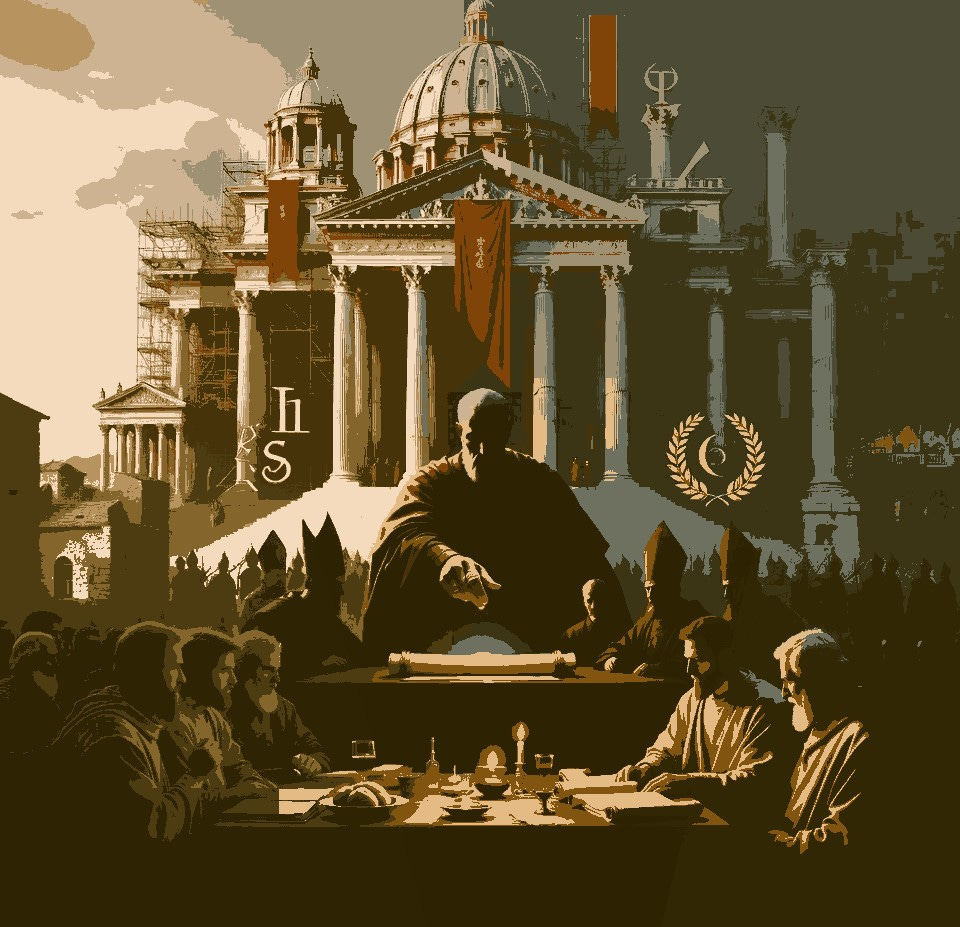
Picture the post-Nicaea boardroom in 325, with Alexander of Alexandria and his eager deacon Athanasius high-fiving over the fresh org chart while the last rigorist holdouts are quietly escorted out by legionaries. The Lapsi winners did not just survive the persecution. They franchised the church, turned local elders into middle management, and traded biblical feasts for a state-approved calendar that still smells faintly of Sol Invictus and philosophical incense.
The apostles left behind a scrappy network of house churches, shared meals, and elders chosen per congregation, exactly as Paul and Barnabas did in every city. What emerged after 325 was a top-heavy Roman knockoff with creeds, cathedrals, and tax exemptions. The scholars who spent lifetimes tracing this mutation never meant to hand us the indictment, yet their own words do the job better than any rant. The cumulative weight of their research arms the case for repentance with scholarly proof that leaves the self-proclaimed guardians of orthodoxy looking like they have been defending a counterfeit with monopoly money.
The Philosophical Chop-Shop
Where Apostolic Obedience Met Greek Philosophy and Got Repainted as Orthodoxy
The philosophical chop-shop is where the real vandalism happened, and it started long before Constantine ever dreamed of a vision at the Milvian Bridge. The primitive movement ran on simple obedience and biblical rhythm, with local elders appointed in every congregation as Paul instructed in Acts 14, and feasts kept according to the statutes in Leviticus 23 that Paul himself upheld in 1 Corinthians 5 as shadows of Christ. Greek paideia turned it into a philosophy department overnight.
Edwin Hatch laid it out plainly in his masterful dissection of how the church absorbed Greek ideas and usages: the shift from conduct to creed coincided exactly with the move from Semitic soil to Greek. Suddenly elders were not humble shepherds tending their flocks but metaphysical referees guarding concepts like homoousios and hypostases that would have left the apostles scratching their heads in bewilderment. Adolf von Harnack called dogma the Greek spirit on the soil of the gospel, and he was right, even if he celebrated the result as progress.
The apostles never sat around debating eternal generation or the precise mechanics of the Trinity while ignoring the clear command to keep the feasts. They broke bread in homes, kept the feasts, and appointed local overseers who led without titles or pomp. The Nicene upgrade replaced all that with a creed that needed a pagan emperor to enforce it through exile and confiscation.
Werner Jaeger and Harry Austryn Wolfson fill in the receipts: Plato’s forms, Aristotle’s logic, and a dash of Neoplatonic hierarchy gave the Lapsi elites the intellectual cover to centralize power and declare their version the only one. Arthur J. Droge shows how early Christians even rewrote their own history to make Moses the father of Greek philosophy, a desperate bid to legitimize the Hellenizing drift that turned the gospel into a classroom exercise. Charles Foster Kent’s work on the makers and teachers of Judaism reminds us that the original matrix was Jewish through and through, not a blank slate waiting for Greek paint.
What began as house churches echoing Romans 16 and Philemon 1 ended as basilicas funded by the same state that had just finished martyring the faithful. The garage sale of apostolic simplicity became a Roman franchise complete with middle management, a dress code, and mandatory attendance at the philosophy seminar. The Lapsi winners did not just launder their betrayal through imperial favor. They laundered the gospel through the Academy until the original product was unrecognizable to anyone who actually read the New Testament.
The Border Patrol
How Nicaea Invented Religion and Deported the Jewish-Christian Remnant
The border patrol arrived right on schedule at Nicaea, and it was not a gentle customs check. Daniel Boyarin’s partition thesis is devastating because it comes from an outsider who simply follows the documents without a dog in the fight. Before Constantine, there was no clean line between Judaism and Christianity. There were Torah-keeping followers of Jesus who saw themselves as the true Israel, continuing the rigorist stream that ran from James through the Meletians and Donatists we met in Lapsi Lotto.
Nicaea did not settle doctrine. It invented religion as a category and declared the Jewish-Christian option illegal. Hugh Schonfield, Jean Daniélou, and Geza Vermes supply the human faces: the Ebionites and their cousins were not fringe cranks. They preserved the original calendar, the local elder model, and the refusal to bend the knee to Caesar. Jacob Neusner shows how Judaism itself had to reformulate in reaction to the new Christian empire, underscoring the artificiality of the split that turned brethren into border violators.
The same Lapsi lotto winners who torched Donatist libraries in North Africa made sure the Jewish-Christian receipts never made it to the franchise meeting. Suddenly the church that began in Jerusalem synagogues was declaring Passover observance a Judaizing heresy worthy of exclusion. Constantine’s own letter to the absent bishops drips with contempt: let us have nothing in common with the detestable Jewish crowd. The apostles would have read that and reached for the same verse we do: you shall not add to the word that I command you, nor take from it.
Paula Fredriksen traces how the New Testament images of Jesus were reshaped to fit this new Gentile mold, turning a Jewish Messiah into a cosmic abstraction detached from His own feasts. The border lines were not drawn by the Spirit moving in council as in Acts 15. They were drawn by the sword and the pen of those who had already sold out once during the persecution and now needed to protect their newly won power.
The very act of drawing those lines created the heretic category so the Lapsi winners could stay in power while claiming apostolic succession. It is the ultimate irony: the church that began as a Jewish sect became the institution that treated its Jewish roots as a contagious disease.
The Subversion Files
When the Church Stopped Being a Subversion and Started Being the Establishment
The subversion files read like a corporate takeover manual written by the devil himself, and Jacques Ellul’s diagnosis lands like a hammer on the nail. Christianity became the opposite of the gospel the moment it stopped being a subversion and started being the establishment. John Howard Yoder piles on with the royal priesthood of all believers versus the clerical castes that replaced them, showing how the laity was pushed to the sidelines while a professional priesthood, complete with tax breaks from the Codex Theodosianus, took the wheel and never looked back.
Alexandre Faivre traces the emergence of the laity as a distinct and diminished class, a development that would have horrified the Apostles who saw every believer as a priest-king in the order of Melchizedek. Ramsay MacMullen shows the mechanics on the ground: mass conversion happened not through persuasion but through miracles, money, and military pressure that turned the cross into a branding iron. The same empire that burned incense to pagan gods now burned incense to bishops and called it progress.
Edward Gibbon, writing as a skeptic, still could not hide the irony: the church that escaped persecution by the skin of its teeth turned around and used the same sword against its own rigorist brethren. The Lapsi had learned the lesson well. Bend the knee to Caesar, get the tax exemptions, and let the state handle the heretics while you rewrite the rules.
Robert Louis Wilken and Robert M. Grant document how the Christians became the Romans they once defied, adopting the very structures of power that had crucified their Lord. Richard Fletcher and Arthur Darby Nock trace the barbarian conversions that followed, showing how the pattern repeated: power over purity, every single time.
Scripture’s warning rings louder than any creed: what fellowship has light with darkness? The church answered by yoking itself to the empire and calling the result orthodoxy, then spent centuries wondering why the fire went out. F.C. Baur’s church history of the first three centuries reveals the early tensions between Jewish and Gentile factions that Nicaea resolved by sidelining the former permanently. Abraham J. Malherbe and the broader social studies confirm the world of the apostles was urban, house-based, and egalitarian, not the clerical pyramid that followed and demanded submission.
The Lost Receipts
Opening the Suppressed Files and Finding the Original Blueprint
The lost receipts are the most heartbreaking evidence of all, and they prove that the Apostolic design was never obsolete or in need of upgrade. Bart Ehrman, Elaine Pagels, and Paula Fredriksen open the suppressed files and the picture is unmistakable. The earliest communities were not waiting for Nicaea to invent Christianity. They were living the Jewish-Christian way: feasts on biblical schedule, elders chosen locally, no titles, no lording, no state protection.
Robert Eisenman and James Tabor, even with their own quirks, hand us the Dead Sea parallels and James’s leadership that prove the rigorist stream was the mainstream until the hierarchy needed scapegoats to consolidate power. James Parkes and Paula Fredriksen pinpoint the Easter vote at Nicaea as the moment antisemitic rhetoric became official policy. Colossians 2:16–17 and 1 Corinthians 5:7–8 suddenly became optional. Leviticus 23 became embarrassing. The very feasts Paul defended as shadows of Christ were rescheduled to avoid looking Jewish.
The Lapsi winners did not just win the lotto. They rewrote the rules so the original players could never cash in again. E.P. Sanders and Wayne A. Meeks show how Paul’s urban communities were house-based and mutual, a far cry from the hierarchical model that emerged and demanded titles like father and metropolitan. Uta Ranke-Heinemann and the broader studies on Hellenism remind us that the very ideas of Greek ethics and philosophy were grafted onto the gospel like foreign stock onto a native vine.
The evidence is overwhelming. The myths are cracked. The imitation stands exposed as the cheap knock-off it always was.
The Indictment from Scripture
Why the Whole Upgrade Was Never Authorized
Yet Scripture refuses to stay silenced, and that is where the case for repentance becomes irresistible. Matthew 23 still thunders against titles and lording, calling all believers brothers and sisters with one Father and forbidding the very hierarchies that Nicaea enshrined. First Peter 5 still commands elders to shepherd without being lords over the heritage, feeding the flock willingly and not for filthy lucre or by constraint.
Colossians 2 still defends the feasts and Sabbaths against judgment, declaring them shadows of Christ that no man should condemn or alter. Revelation 22 still curses anyone who adds or subtracts from the Words of the Prophecy. The Apostolic design was never meant to be upgraded. It was meant to be obeyed.
The Constantinian settlement, the Nicene creeds, the metropolitan power grabs, the replacement calendar, none of it rests on a single verse that says the church should trade its crown for a seat at the emperor’s table. Every scholar we have examined, even those who celebrate the development, ends up documenting the mutation. The Lapsi lotto winners from Lapsi Lotto did not stop at reintegration. They Hellenized the whole operation until the original blueprint was buried under layers of Greek philosophy, Roman law, and imperial favor. Jaroslav Pelikan traces the emergence of the Catholic tradition as a gradual process, but the sources show it was a deliberate power play that violated Deuteronomy 4:2 at every turn.
This is the moment for repentance, not nostalgia or another round of ecumenical hand-wringing. The church does not need another council or another creed. It needs to bulldoze the cathedrals of compromise, scatter the relics of power, and rebuild on Scripture’s Rock where no Lapsi fraud can hide.
Restore the local elders, chosen in every congregation as the Apostles commanded. Reclaim the Biblical feasts, kept according to the eternal statutes that Paul never abandoned. Ditch the titles and the hierarchies that Matthew 23 explicitly forbids. Refuse the unequal yoke with the state that 2 Corinthians 6 warns against.
Anything less and we are still playing the same rigged game that began when the first Lapsi grabbed the chariot reins and drove it straight into the Greek body shop. The Apostles are watching from the cloud of witnesses. Scripture is clear, sharper than any two-edged sword. The exit ramp is marked Repentance, and it has always been the only way home.
The myths are flayed. The imitation stands exposed. The call remains: come out from among them and be separate.
The garage sale is over. The franchise is a bust. It is time to return to the original!
Bibliography
Jean Daniélou’s The Theology of Jewish Christianity stands as a foundational exploration of the Jewish roots that were systematically erased in the post-Nicaea era.
Adolf von Harnack’s History of Dogma traces the Hellenizing process with unflinching precision.
Charles Foster Kent’s The Makers and Teachers of Judaism provides essential context on the Jewish matrix from which Christianity emerged.
Arthur J. Droge’s Homer or Moses? Early Christian Interpretations of the History of Culture reveals the cultural appropriations that reshaped the faith.
Harry Austryn Wolfson’s The Philosophy of the Church Fathers dissects the Platonic influences that became orthodoxy.
Edwin Hatch’s The Influence of Greek Ideas and Usages Upon the Christian Church remains the classic on the shift from conduct to creed.
Jaroslav Pelikan’s The Christian Tradition: A History of the Development of Doctrine, Volume 1: The Emergence of the Catholic Tradition documents the gradual mutation.
Alexandre Faivre’s The Emergence of the Laity in the Early Church charts the marginalization of ordinary believers.
John Howard Yoder’s The Royal Priesthood: Essays Ecclesiological and Ecumenical indicts the clerical takeover.
Jacques Ellul’s The Subversion of Christianity delivers the prophetic warning against empire.
Edward Gibbon’s The History of the Decline and Fall of the Roman Empire offers the skeptic’s ironic perspective.
Daniel Boyarin’s Border Lines: The Partition of Judaeo-Christianity exposes the artificial borders.
Hugh J. Schonfield’s The History of Jewish Christianity preserves the voices of the suppressed.
Robert Eisenman’s James the Brother of Jesus: The Key to Unlocking the Secrets of Early Christianity and the Dead Sea Scrolls uncovers the James-centered rigorism.
James D. Tabor’s The Jesus Dynasty: The Hidden History of Jesus, His Royal Family, and the Birth of Christianity highlights the dynastic elements.
Werner Jaeger’s Early Christianity and Greek Paideia maps the educational takeover.
Ramsay MacMullen’s Christianizing the Roman Empire: A.D. 100–400 details the mechanics of mass conversion.
James Parkes’s The Conflict of the Church and the Synagogue: A Study in the Origins of Antisemitism traces the roots of division.
F.C. Baur’s Church History of the First Three Centuries reveals the early tensions.
Robert Louis Wilken’s The Christians as the Romans Saw Them shows the Roman perspective.
Bart D. Ehrman’s Lost Christianities: The Battles for Scripture and the Faiths We Never Knew opens the lost archives.
Paula Fredriksen’s From Jesus to Christ: The Origins of the New Testament Images of Jesus reshapes the origins narrative.
Arthur Darby Nock’s Conversion: The Old and the New in Religion from Alexander the Great to Augustine of Hippo examines the conversion process.
Richard Fletcher’s The Barbarian Conversion: From Paganism to Christianity extends the pattern.
Elaine Pagels’s The Gnostic Gospels challenges the canonical monopoly.
Jacob Neusner’s Judaism and Christianity in the Age of Constantine shows the mutual reformulation.
E.P. Sanders’s Paul and Palestinian Judaism restores the Jewish context.
Geza Vermes’s Christian Beginnings: From Nazareth to Nicaea traces the trajectory.
Robert M. Grant’s Early Christianity and Society analyzes the social structures.
Abraham J. Malherbe’s Social Aspects of Early Christianity provides the communal details.
Wayne A. Meeks’s The First Urban Christians: The Social World of the Apostle Paul describes the house-church reality.
Uta Ranke-Heinemann’s Putting Away Childish Things: The Virgin Birth, the Resurrection, and Other Reforming Ideas questions the dogmas.
The Jewish Encyclopedia entry on Hellenism outlines the cultural fusion.
The Stanford Encyclopedia of Philosophy entry on Ethics in Ancient Greece illuminates the philosophical roots.
Harvard Divinity School resources on Early Christian Studies offer modern scholarly overviews.
Edwin Hatch’s The Organization of the Early Christian Churches details the institutional growth.
Edwin Hatch’s The Growth of Church Institutions traces the expansion.
Robert Eisenman and Michael Wise’s The Dead Sea Scrolls Uncovered reveals the parallels.
Edwin Hatch and Henry Redpath’s A Concordance to the Septuagint aids textual analysis.
Robert Eisenman’s “Paul as Herodian,” from the Journal of Higher Criticism, proposes alternative views.
Robert Eisenman’s Maccabees, Zadokites, Christians, and Qumran connects the dots.
Edwin Hatch’s Essays in Biblical Greek examines the linguistic shifts.
Great article! I had to look up what the word "Lapsi" meant, but that was probably my own fault for not already knowing it. Your post is academically comprehensive and polemical, two traits that must be combined well for a message like this to be spread effectively. Keep up the good work exposing the rot in our mainstream ecclesiastical establishment! Shalom.