
Branded for the Book
The Forgotten Hebraic Restorationists Who Refused to Let Greco-Roman Fog Obscure Messiah's Apostolic Design

We sit down with our coffee on constant drip, sipping from our warm mugs while opening the old books once more, friends. Picture this if you will: It is 1618 or thereabouts in merry old England under good King James. The bishops and Star Chamber worthies, those self-appointed guardians of pure orthodoxy, are in a fine lather. A former schoolmaster turned preacher named John Traske has dared to take the whole Bible seriously. He and his little band have begun keeping the seventh-day Sabbath as the fourth commandment plainly reads, avoiding swine’s flesh where Scripture marks it unclean for the covenant people, and even tasting something of the Passover patterns that point to our Messiah. Nothing invented, mind you—just plain reading of the text without the usual Greco-Roman philosophical fog or selective Sunday-only literalism that somehow skips the parts that pinch.
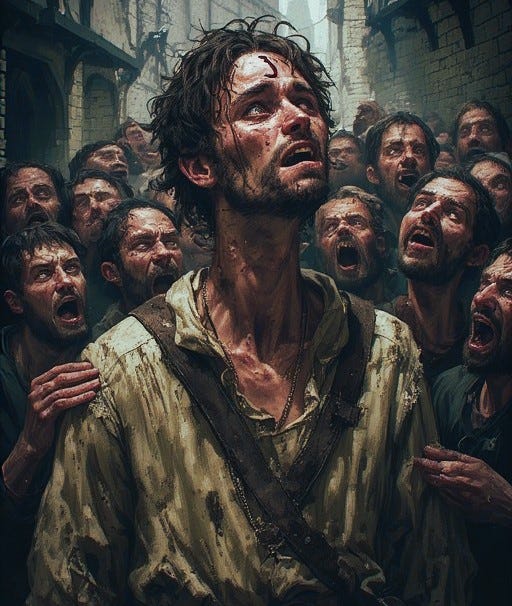
And how do the guardians of the faith respond? Not with open debate from the Scriptures, oh no. They haul him before the Star Chamber, that marvelous engine of royal and ecclesiastical justice. They whip him from the Fleet prison to Westminster with a paper on his head declaring his crimes. They nail one ear to the pillory, then the other in Cheapside for all the good citizens to gawk at. And then, in a flourish of pastoral tenderness, they burn the letter “J” into his forehead with a hot iron— “J” for the Jewish opinions he had supposedly broached. Because nothing says “defending the pure Gospel” quite like hot iron and public humiliation, does it? We can almost hear Bishop Lancelot Andrewes intoning with solemn gravity: “It is a good work to make a Jew a Christian, but to make Christian men Jews hath ever been holden a foul act.”
Traske’s wife Dorothy (a true martyr) would endure prison for some fifteen years, refusing release on terms that compromised conscience, eventually dying there on bread and water. Return Hebdon, a Sussex landowner who followed the same path, wrote from his own cell and likewise perished in custody. Others fled to Amsterdam seeking the Unleavened Bread of God’s Word, so deep was their hunger for the literal patterns of Scripture. Traske himself (obviously coerced) recanted under pressure in a 1620 treatise, but the scar remained—a walking billboard for the establishment’s fear that someone might actually restore Biblical culture to the Assembly of Messiah’s people.
We tell this story not to wallow, but because Traske makes the perfect poster child for what happens when Restorationism collides with institutionalized comfort. These men and women were not inventing a new religion. They were reaching back for the Apostolic ways Messiah taught—Hebraic roots intact, pronomian in grateful obedience, shaped by the Biblical culture of covenant, and governed after the pattern Jethro wisely advised Moses in Exodus 18: able men who fear God, men of Truth hating covetousness, ruling in decentralized elder-led assemblies rather than the top-down pyramids Rome and its Protestant imitators so loved. And for that, they received branding, nailing, whipping, fines, and lifelong shame. The “orthodoxy” that claimed to stand on Scripture alone proved remarkably allergic to large portions of it.
Yet the story does not stop with Traske’s branded forehead. Across the decades that followed, a scattered chorus of scholars, pastors, and plain believers kept sounding the same note, even when it cost them exile, controversy, or cautious anonymous circulation of their writings. They called the Church back to Restorationism: the literal hope of Israel’s future conversion and national restoration as precursor to millennial glory, not some permanent Greco-Roman replacement. They insisted on Hebraic roots for accurate reading of both Testaments. They embraced a pronomian faith that saw obedience to God’s Commandments as the joyful fruit of grace, not a ladder to earn it. They recovered Biblical Culture in worship, ethics, and daily life. And they pointed to Apostolic design in the governance of the assembly—modeled on the wilderness congregation and Jethro’s counsel—rather than episcopal hierarchies borrowed from pagan empires or philosophical schools.
The Branded Pioneer and the Wilderness Pattern
We begin our journey proper with one of the earliest and most formidable of these voices, Henry Ainsworth, the Separatist scholar who fled to Amsterdam and poured his life into a masterpiece of Hebraic scholarship. In his Annotations upon the Five Books of Moses (completed in stages 1616–1621), Ainsworth did not dabble in speculation. He went straight to the Hebrew text, comparing it diligently with the Targums, the writings of Maimonides, and other ancient monuments of the Hebrews. His goal was never to elevate rabbinic tradition above Scripture—far from it. He used those sources as tools to illuminate the Mosaic law and ordinances, arguing that the true pattern for the Church of Christ is found in the wilderness congregation God gave to Israel, not in the evolving canons of Rome or any later Greco-Roman overlay.
Ainsworth wrote with painstaking care on the sacrifices, the feasts, the civil and ceremonial laws, showing how they formed a coherent divine blueprint. He explained the tabernacle and its furniture, the roles of priests and Levites, and the covenant structure of the people as a Holy Nation under God’s direct rule mediated through elders and judges. Time and again he returned to the idea that these things were written for our learning and example. The Church, he insisted, should recover that same covenantal, congregational pattern—decentralized, accountable, rooted in the fear of God and the plain Words of Scripture—rather than importing hierarchical inventions that smelled more of imperial courts than of Sinai or the upper room.
We smile a little as we imagine the discomfort this caused. Here was a Separatist, already suspect for rejecting the established church order, using Jewish sources not to “Judaize” but to strip away later accretions and restore the original design. Critics accused him of over-reliance on rabbis, yet Ainsworth repeatedly subordinated everything to the holy Scriptures themselves. The Mosaic pattern, he showed, was no temporary shadow to be allegorized away into Greek abstractions. It was the living framework in which Messiah’s Apostles first walked and taught. Restorationism meant returning to that framework, Hebraic roots and all, with a pronomian heart that delighted in God’s Commandments as the psalmist did.
From Ainsworth’s Amsterdam study the influence crossed the ocean to New England. John Cotton, that foundational voice of American Puritanism, took up the same theme in The Way of the Churches of Christ in New-England (1645). Cotton argued explicitly that the structure of the visible church should be modeled on the “Hebraic” congregation of the wilderness. He pointed to Exodus and Acts 7:38, describing the church as a covenant community of saints gathered under Christ, ruled by elders chosen according to the qualities Jethro advised Moses—able, God-fearing, truthful men who would bear the burden with him rather than lording over the flock after the manner of Gentile kings or Roman prelates.
Cotton rejected episcopal hierarchy as a Greco-Roman invention foreign to the Apostolic pattern. He wrote that the New England way sought to restore the primitive simplicity: congregations autonomous yet in fellowship, discipline exercised locally by the brotherhood, worship shaped by the whole counsel of God rather than human traditions. We can almost hear the wry Puritan humor beneath his measured prose when he contrasts this with the pomp and ceremony imported from the old world. The wilderness congregation was no democracy of the flesh but a theocratic republic under Scripture—precisely the Apostolic design that Jethro’s counsel helped establish for Israel and that the early church mirrored before Greek categories and imperial models began to blur the lines.
These early voices set a trajectory. Restorationism was not mere nostalgia. It was a forward-looking recovery of the past so that the Church could walk rightly into the future God promised—Hebraic roots preserved, pronomian obedience flowing from union with Messiah, Biblical culture shaping life together, and assemblies governed after the decentralized wisdom of Jethro rather than centralized power that too easily apes Pharaoh or Caesar.
Illuminating the Apostles and the Pietist Fire
We move now to one of the most significant scholarly contributions of the age, the work of John Lightfoot. In his massive Horae Hebraicae et Talmudicae (published in stages 1658–1678), Lightfoot set out to explain the New Testament by citing parallel passages and customs from the Talmud and Midrash. He argued forcefully that the Apostles were thoroughly Hebraic in their thought and expression. The Church, he believed, had lost its way by rushing too eagerly into Greek philosophical categories that twisted plain Biblical truths into abstract systems.
Yet—and we emphasize this clearly for any reader who might otherwise stumble—Lightfoot held the Talmud in far lower esteem than Holy Scripture itself. He mined it for historical and cultural illumination the way a careful prospector pans a stream for gold amid the gravel, but he never treated it as authoritative. In his own words, the Talmudic writers “abound with trifles” and “obscurities,” full of “trifling in sense and roughness in expression.” He described them with dry wit: there are no authors who more “affright and vex the reader” yet also “entice and delight him.” In no writers is there “greater or equal trifling,” yet by skill Christians can render them “most usefully serviceable” to interpreting the New Testament. To the Jews themselves, he noted, these writings recommend “toys, and destruction, and poison,” but for the Christian student they can clarify the Hebraic background of Messiah’s Words and the Apostles’ teaching.
Lightfoot poked fun at the myths, foolish fables, and sometimes ridiculous takes he encountered—dialect mishaps, exaggerated priestly servant stories, superstitious customs that he labeled absurd or contradictory. He laughed at the follies while treasuring any genuine contextual light they shed on Galilean life, Pharisaic debates, or temple practices that illuminated the Gospels. This was no “Judaizing.” It was honest scholarship: using secondary sources critically to recover the Hebraic roots without elevating them above the inspired text. Ainsworth had done similarly, and Jessey would follow. The goal remained Restorationism—returning the Church to the Apostolic mindset Messiah taught, not swapping one set of extra-Biblical traditions for another.
Lightfoot’s work reinforced the pronomian impulse. By recovering the Jewish context of commands, parables, and controversies, he helped readers see that grace does not abolish God’s righteous standards but empowers joyful obedience to them. The assembly, rightly ordered, would reflect that same Hebraic spirit—elders ruling wisely after Jethro’s model, the whole people living out Biblical culture in a hostile world. Persecution for such views continued in subtler forms, but the light kept spreading.
We turn next to the Pietist stream that arose on the Continent, bringing fresh fire to the same vision. Philipp Jakob Spener’s Pia Desideria (1675) served as the manifesto of Pietism. Spener called for a return to “the whole Bible,” with special emphasis on serious study of the Old Testament as the path to personal and communal renewal. He critiqued the dry, philosophical disputations of university theologians—those endless hairsplitting arguments that smelled more of Aristotle and Plato than of Moses and the Prophets. True Christianity, he insisted, flourishes when believers immerse themselves in Scripture’s plain sense, allowing the Hebraic spirit of the early church to breathe life into dead forms.
August Hermann Francke carried this forward in his Manuductio ad Lectionem Sacrae Scripturae (1693). This guide to reading Scripture warned explicitly against the “vanity” of Greek philosophy in interpretation. Francke urged students to prioritize the Hebraic context as the primary key to understanding God’s will. Only by recovering that context could the Church escape the fog of rationalism and philosophical overlay that threatened to turn living oracles into abstract systems.
Johann Albrecht Bengel, in his classic Gnomon Novi Testamenti (1742), brought rigorous Pietist scholarship to the New Testament while insisting that the “Hebraic spirit” of the early church remained the sure antidote to the rationalism and “pagan” philosophy infecting the Enlightenment-era church. Bengel attended carefully to Hebraisms in the Apostolic Greek and defended the Jewish stylistic and interpretive world as essential for faithful reading.
These Pietists were no wild enthusiasts. They were learned men who saw the danger of a Christianity detached from its Hebraic roots. They championed Restorationism by calling believers back to the whole Bible, pronomian delight in God’s Law written on the heart, and Biblical culture expressed in holy living. Assemblies, they implied, should reflect the simple, Spirit-led order of the Apostolic age—governed by wise elders after the pattern Jethro gave Moses—rather than the scholastic or hierarchical models that had grown up in the intervening centuries. Their emphasis on personal renewal and communal Bible study kept the vision fresh even as older Separatist and Puritan streams faced new pressures.
Literal Futures, Hebrew Law, and the Persecution Chorus
Thomas Brightman’s radical literalism on Jewish restoration, Increase Mather’s New England call for Israel’s salvation as millennial precursor, Henry Jessey’s remarkable philo-Semitic yet evangelistic writings, John Selden’s massive case for grounding civil law in Hebrew discipline rather than Roman models, and Samuel Rutherford’s appeals to Old Testament patterns against imperial and papal power. The persecution chorus continues as well, with fresh examples of silencing, imprisonment, and rhetorical branding that echo Traske’s hot iron in subtler but no less real ways.
We pick up with the fire of Restorationist hope burning brighter even as the institutional shadows lengthened. Thomas Brightman stands out as one of the most radical and controversial Puritan voices of the early seventeenth century. In A Revelation of the Apocalypse (1609), Brightman offered a historicist reading that refused to spiritualize away the future of Israel. He argued for the literal restoration of the Jewish people to their land and their national conversion as a key precursor to the millennial reign of Christ. This was no gentle scholarly aside. It directly challenged the dominant “Western” view that the Church had permanently replaced Israel, rendering Old Testament promises to Judah and the tribes as mere allegories for Gentile believers.
Brightman’s work was explosive precisely because it took the prophets at face value. He saw the apocalyptic visions pointing to a future glory for physical Israel alongside the ingathering of the Gentiles, not in competition but in fulfillment of the Abrahamic covenant. The Church, he insisted, would only reach its full Apostolic maturity when it recovered this Hebraic eschatological framework—roots sunk deep in the promises made to the fathers, pronomian obedience flowing from renewed hearts, and assemblies ordered according to the simple covenant patterns of Scripture rather than Greco-Roman imperial models. For advancing such views, Brightman earned sharp criticism and marginalization in his own day. The comfort of supersessionist allegory stroked the egos of Western supremacists which was safer for those who preferred their theology comfortable and their Old Testament neatly spiritualized.
Across the Atlantic, Increase Mather took up a similar burden in New England. His The Mystery of Israel’s Salvation (1669) argued that the conversion of the Jews—all tribes, in a national sense—remained a necessary precursor to the glorious millennial reign of Christ. Mather’s fascination with the “Hebraic” future of the Church was complex but unwavering. He rejected any notion that God had cast off His ancient people forever. Instead, he saw their restoration and salvation as the great hinge upon which broader kingdom blessing would turn. This was Restorationism in full bloom: the Church called to prepare itself by recovering its own Hebraic roots, embracing Biblical culture once more, walking in pronomian delight rather than antinomian looseness.
Mather’s voice joined a transatlantic chorus. Yet even in Puritan New England, such emphases could invite suspicion. The temptation to allegorize the Old Testament into harmless moral lessons or Greek-style abstractions remained strong. Mather and those like him insisted the literal sense must stand. Only then could the Apostolic design shine through—Congregations functioning as covenant communities under Christ, governed not by distant hierarchies but by qualified elders bearing the burden with the people, exactly as Jethro counseled.
Henry Jessey emerges here as perhaps the most remarkable bridge figure of the entire period. This Cambridge-educated Baptist pastor, known to some contemporaries as “Jessey the Jew” for his profound rabbinical learning, combined deep Hebraic scholarship with passionate Restorationism. In The Glory and Salvation of Jehuda and Israel (1650), Jessey addressed the Jewish people directly with remarkable respect and evangelistic urgency. He drew on rabbinic, Talmudic, and even Kabbalistic sources alongside the Old Testament prophecies to demonstrate the Christian Messiah while showing genuine honor for the Jewish nation as the natural branches of the olive tree.
Jessey wrote movingly: “If I found more truth on your side than on that of the Christians, all advantages, all honor, and all riches of the world would not prevent me from embracing your truth.” He labored for the readmission of Jews to England in the 1650s, collaborating with Menasseh ben Israel and others, and produced works such as A Narrative of the late Proceedings at White-Hall concerning the Jews (1656) and An Information Concerning the Present State of the Jewish Nation (1658). Some of these circulated cautiously or with anonymous elements to avoid backlash. Jessey also joined efforts for a new Bible translation project that aimed to restore Hebraisms in the New Testament and reduce the obscuring influence of Greek and Latin “strange tongues.”
Importantly, Jessey’s approach mirrored Lightfoot’s careful balance. He used Jewish sources for illumination and historical context, never granting them equality with inspired Scripture. He poked at rabbinic fables and superstitions where they appeared foolish, much as Lightfoot did with Talmudic myths, while treasuring any light they shed on the Hebraic world in which Messiah and the Apostles walked. This was no blind “Judaizing.” It was Restorationism at work.
Jessey’s efforts faced indirect pressures—nonconformity carried risks under the High Commission and later regimes—but his writings helped keep the vision alive amid the English Revolution’s upheavals. The same Restorationist hope that animated Brightman and Mather burned in him: a literal future for Israel as part of God’s larger plan, calling the Church back to its own neglected roots.
We turn now to the realm of law and civil order, where the Hebraic impulse proved equally disruptive to comfortable Greco-Roman assumptions. John Selden, the great jurist rather than formal theologian, produced one of the most massive and influential works of the age in De Jure Naturali et Gentium juxta Disciplinam Ebraeorum (1640). Drawing extensively on Hebrew discipline and rabbinic sources, Selden argued that natural and civil law could be grounded far more securely in the Old Testament framework than in Roman law traditions. Puritans devoured this work because it offered a Biblical alternative to the imperial legal models that had shaped so much of European Christendom.
Selden’s scholarship reinforced the broader Restorationist current. Civil society, like the church Assembly, should reflect covenantal patterns rooted in Sinai rather than pagan republics or papal decretals. The decentralized wisdom of Jethro—able men ruling justly under God—provided a model for both ecclesiastical and civil governance that avoided the top-down tyrannies so often justified by Greco-Roman philosophy or canon law. Pronomian instincts flourished here: God’s Commandments were not burdensome relics but righteous guides for a holy people.
Samuel Rutherford added his Presbyterian voice in The Due Right of Presbyteries (1644). While focused on church government, Rutherford repeatedly appealed to the Hebraic model of the Old Testament state and congregation to critique both monarchical absolutism and papal claims. He contrasted the covenantal, elder-led structures of Israel with the “Greco-Roman” imperial models that had corrupted both state and church. For Rutherford, true Apostolic design meant recovering the wilderness pattern: assemblies governed by qualified elders after Jethro’s counsel, exercising discipline and oversight in a decentralized manner that honored the priesthood of all believers while maintaining order. This was no democracy of the flesh but a Biblical Republic under Scripture.
We laugh a little—bitterly, perhaps—at how these appeals threatened the establishment. Rutherford and Selden were no wild radicals in the Ranter sense, yet their insistence on Hebraic patterns over inherited Roman ones earned them suspicion and pushback. The same dynamic that led to Traske’s branding played out in subtler ways: fines, exclusion from preferment, or rhetorical accusations of unsettling the peace. Restorationism, whether in eschatology, hermeneutics, or polity, kept challenging the comfortable synthesis of Greek philosophy and Roman order that had quietly reshaped so much of Protestant practice.
Throughout these decades, the persecution chorus never fully fell silent. Traske’s branded forehead remained the most graphic symbol, but fresh examples kept appearing. Theophilus Brabourne, writing in the late 1620s and early 1630s, defended the moral perpetuity of the fourth Commandment and the seventh-day Sabbath in works such as A Discourse upon the Sabbath Day and A Defense of the Most Ancient and Sacred Ordinance of God’s, The Sabbath Day. He faced deprivation, fines, and silencing by the High Commission, though he stopped short of full separation. Francis Bampfield, a later Hebraist and Seventh-Day Baptist leader, endured multiple imprisonments for his literalism on immersion and Sabbath observance. These men, like Traske’s followers Dorothy and Return Hebdon, paid real prices—lost livings, years in damp cells, social ostracism—for insisting that Biblical culture and pronomian obedience belonged in the life of Messiah’s people.
We note again the graphic reality: whippings, ear-nailing, forehead branding with the “J” of supposed Judaizing, long imprisonments, and exile. The institutionalized “orthodoxy”—whether Papist in origin or Protestant in imitation—reacted with visceral fear whenever someone took too much of the Old Testament literally or suggested the Church had drifted from its Hebraic Apostolic design. They preferred their allegories, their philosophical categories, their Sunday customs, and their hierarchical comforts. Yet the branded and the imprisoned kept whispering the same conclusion: Restore the Body of Christ to the ways Messiah taught. Keep the Hebraic roots. Walk in pronomian faith. Live out Biblical culture. Govern the assemblies after Jethro’s wise counsel rather than the models of empire or academy.
The Pietist stream we touched on earlier added devotional urgency to this vision. Spener, Francke, and Bengel called believers away from dry disputations and back to the whole Bible. They warned against the vanity of Greek philosophy that had infected even Protestant theology. Their emphasis on personal and communal renewal through serious Old Testament study kept Restorationism alive in new generations. Bengel especially saw the Hebraic spirit of the early church as the antidote to Enlightenment rationalism. These were not calls to legalism but to joyful, Spirit-empowered obedience—pronomian at heart, rooted in covenant grace.
We have now surveyed the major voices and their shared burden. What emerges is no scattered eccentricity but a coherent counter-current running through Separatist, Puritan, Presbyterian, and Pietist circles. They differed in emphasis and context, yet they converged on the same thunderous testimony. The Church had allowed Greco-Roman categories—philosophical, hierarchical, allegorizing—to obscure the plain Apostolic pattern. Restoration meant stripping away that fog and returning to Messiah’s own Hebraic soil.
The Living Chorus and the Final Summons
Letting the voices themselves now rise in a living chorus. We will not repeat what has already been laid out in fresh detail. Instead, we allow the primary witnesses to speak directly, weaving their own words into a unified testimony that arrives at the same Restorationist conclusion without circling old ground. Hear them as they testify.
Henry Ainsworth, in the painstaking labor of his annotations, declares that the Mosaic institutions were given “for our learning” and that the Church does well to recover “the true pattern” shown in the wilderness rather than trusting later inventions. He writes of the tabernacle and its service: “The Lord would have all things done according to the pattern showed in the mount,” insisting that this divine blueprint extends beyond shadows to instruct the New Covenant people in holy order and covenant life. The Hebraic roots are not optional decoration; they are the soil in which Apostolic faith first grew.
John Cotton echoes and applies this in New England soil: “The Churches of Christ in New-England are framed according to the pattern of the first Churches in the Apostles’ times, which pattern was taken from the example of the Church of the Jews in the wilderness.” He rejects episcopal lordship as “a device of man, borrowed from the Gentiles,” calling instead for congregations gathered in covenant, ruled by elders chosen for their wisdom and fear of God—precisely the qualities Jethro advised Moses to seek in Exodus 18. Cotton’s vision is explicitly Restorationist: the Assembly restored to its Apostolic design, Hebraic in pattern, pronomian in its delight in God’s statutes, and shaped by Biblical culture rather than imported pomp.
John Lightfoot, having sifted Talmudic material with scholarly rigor and no small measure of dry humor at its “trifling” and “foolish” elements, concludes that the Apostles thought and spoke as Hebrews. He writes that “the whole New Testament is written in the language and dialect of the Jews,” and that ignoring this Hebraic background leaves us “groping in the dark.” Yet he never confuses the secondary sources with the primary: Scripture stands supreme, the Talmud useful only when it illuminates without contradicting. Lightfoot’s labor serves Restorationism—recovering the mindset of Messiah and His Apostles so the Church can walk once more in that same spirit.
Philipp Jakob Spener, in the heart of Pia Desideria, laments the “dry and barren” state of much contemporary theology and calls for “earnest study of the whole Bible,” especially the Old Testament, as the path to renewal. He warns that philosophical disputations have replaced Living Faith, urging a return to the “Apostolic simplicity” that breathed the Hebraic air of the first believers. Francke reinforces this in his guide to Scripture reading, cautioning against “the vanity of human philosophy” and insisting the Hebraic context is the “primary key” to unlocking God’s will. Bengel adds his precise scholarly voice, declaring that only the “Hebraic spirit” of the early Church can antidote the “pagan philosophy” and rationalist chill creeping over the Enlightenment church. Together they summon believers to a living, whole-Bible faith—Restorationist at its core.
Thomas Brightman refuses to let the Apocalypse be tamed into safe allegory. He writes plainly of “the restoration of the Jews to their own land” and their “national conversion” as events that will usher in greater glory for the Church. The promises to Israel, he insists, are not forever transferred to Gentiles alone; God will yet remember Judah and the tribes. This literal hope fuels Brightman’s call for the Church to purge itself of “Western” supersessionist assumptions and recover its own Hebraic expectancy.
Increase Mather, preaching and writing in New England, declares that “the conversion of the Jewish nation is to be expected” as a glorious work preceding the millennial reign. He sees in this event the fulfillment of covenant promises that will bring blessing to the wider world. Mather’s vision is unabashedly Restorationist: the Church must prepare by returning to its roots, embracing the whole Scripture, and ordering its life according to Apostolic patterns rather than later corruptions.
Henry Jessey, addressing the Jewish people with both respect and urgent gospel hope, writes in The Glory and Salvation of Jehuda and Israel: “We partake of the Messias, and promises, and salvation, that was to the Jewes, as natural branches.” He labors for their readmission and for mutual reconciliation in truth, while pouring himself into Hebrew studies and Bible translation efforts aimed at restoring the original Hebraic flavor of the New Testament. Jessey’s balanced use of sources—illuminating, never elevating—exemplifies the scholarly humility these Restorationists prized. He mocks no sacred text but freely notes where rabbinic writings stray into fable, always subordinating them to the inspired Word.
John Selden, in his monumental study of law according to Hebrew discipline, demonstrates that the nations would do well to ground their jurisprudence in the clear patterns of the Old Testament rather than Roman precedents alone. Rutherford complements this by appealing repeatedly to the Old Testament state and church as the model for resisting both monarchical absolutism and papal claims. Both men point toward a pronomian order—civil and ecclesiastical—shaped by covenant, elder wisdom after Jethro’s counsel, and Biblical culture rather than philosophical or imperial abstractions.
Across all these voices runs the graphic reminder of cost. Traske bore the “J” burned into his forehead for daring to keep the fourth commandment literally and tasting of Mosaic patterns. His wife Dorothy languished fifteen years in prison. Return Hebdon died in custody. Brabourne faced deprivation and fines. Bampfield knew repeated imprisonment. Jessey and others circulated some writings cautiously to avoid similar fates. The establishment—whether wearing Papist robes or Protestant variants—reacted with branding, nailing, whipping, silencing, and exile whenever Restorationism threatened to recover too much of the Hebraic Apostolic design. They preferred their comfortable allegories, their Greek categories, their Sunday customs, and their hierarchical control. We mock the absurdity gently but pointedly: hot iron as pastoral care, rhetorical lynch mobs as defense of orthodoxy, selective literalism that skips the inconvenient portions of the Book while claiming Sola Scriptura.
Yet the testimony converges. These forgotten Reformers, alienated and often ignored, refused to let Greco-Roman fog obscure Messiah’s ways. They called the Church back to Restorationism—the literal hope of Israel’s future as part of God’s plan, the recovery of Hebraic roots for faithful reading, the embrace of pronomian faith as grateful obedience flowing from grace, the living out of Biblical culture in worship and daily life, and the ordering of Assemblies according to the Apostolic design modeled on Jethro advice to Moses: able, God-fearing elders sharing the burden in decentralized covenant communities rather than centralized pyramids of power.
We hear the chorus clearly now. Ainsworth on the Mosaic pattern for the Church. Cotton applying it in New England congregations. Lightfoot illuminating the Hebraic mindset of the Apostles while laughing at Talmudic trifles. Spener, Francke, and Bengel demanding the whole Bible against philosophical vanity. Brightman and Mather lifting up literal Jewish restoration as millennial harbinger. Jessey bridging scholarship and philo-Semitic hope. Selden and Rutherford grounding law and polity in Hebrew discipline. All of them, despite branding and pressure, pointing the same direction: Restore the Body of Christ to the Apostolic ways Messiah taught. Do not ditch the Hebraic roots. Keep the pronomian heart alive. Live the Biblical culture. Govern the assembly after Jethro’s counsel.
We, their heirs, still feel the force of that summons today. The iron is long cold, but the Book burns hotter than ever. Modern rhetorical brandings—those lazy cries of “Judaizer” from Papist traditionalists or moonshine-scented Hillbilly Baptists who fear any serious engagement with the Old Testament—echo the same fear that once heated the branding iron. They reveal more about the branders than the branded. We wear no literal “J,” but we will not flinch from the whole Counsel of God.
The call remains fresh and urgent. Return to the Hebraic roots without apology. Walk in pronomian obedience as the joyful fruit of union with Messiah. Embody Biblical culture in your homes, Assemblies, and public life. Order the governance of the church according to the Apostolic pattern, decentralized eldership rather than the lingering ghosts of empire and academy. Embrace Restorationism: the hope that God will yet fulfill every promise to Israel and bring the Church into fuller maturity as the natural branches are grafted back in.
Friends, the forgotten Reformers have spoken. Their branded, imprisoned, and marginalized voices still cry from the pages: Restore. Recover. Return.
The fog of Greek philosophy and Roman order has lingered long enough. The Apostolic design shines clearest when the Hebraic soil is tended once more. Let us heed them—not with mere nostalgia, but with living faith that delights in the whole Book and trusts the God who wrote it.
If they branded a man for keeping the Sabbath as written, imagine the panic if the whole Church actually started reading the whole Bible again. The bishops might need new irons. We suggest they save the expense. The fire of Scripture is already doing its work.
Primary Sources
Ainsworth, Henry. 1616–1621/1639. Annotations upon the Five Books of Moses, the Book of the Psalmes and the Song of Songs. London (various early editions; modern reprint: Annotations on the Pentateuch or the Five Books of Moses, 2 vols., with memoir). Available via Archive.org.
Bengel, Johann Albrecht. 1742. Gnomon Novi Testamenti. Tubingae: Sumtibus ac typis Io. (Later editions include 1855 critical versions). Available via Archive.org.
Brightman, Thomas. 1609/1611. A Revelation of the Apocalypse (also titled Apocalypsis Apocalypseos). Frankfurt/Heidelberg (English editions followed). Available via Early English Books Online (EEBO) and University of Michigan Digital Collections.
Cotton, John. 1645. The Way of the Churches of Christ in New-England. London: Matthew Simmons. Available via Archive.org and Digital Puritan editions.
Francke, August Hermann. 1693. Manuductio ad Lectionem Sacrae Scripturae. (Later editions include 1706 with additions). Available via Google Books and Archive.org.
Jessey, Henry. 1650. The Glory and Salvation of Jehuda and Israel. London. (Critical discussions in modern scholarship; related works include his 1656 Narrative on the Whitehall Conference).
Lightfoot, John. 1658–1678. Horae Hebraicae et Talmudicae (Hebrew and Talmudical Exercitations). Multiple volumes; Oxford University Press editions (1859 reprint by Robert Gandell). Available via Archive.org.
Mather, Increase. 1669. The Mystery of Israel’s Salvation, Explained and Applyed. London. Available via Early American Imprints and Archive.org.
Rutherford, Samuel. 1644. The Due Right of Presbyteries. London: E. Griffin for Richard Whittaker and Andrew Crook. Available via EEBO and Google Books.
Selden, John. 1640. De Jure Naturali et Gentium juxta Disciplinam Ebraeorum. London. Available via Archive.org.
Spener, Philipp Jakob. 1675. Pia Desideria. (English translation: Pia Desideria, trans. Theodore G. Tappert, Fortress Press, 1964). Original and modern editions available.
Traske, John (and related records). 1618–1620. Star Chamber proceedings and recantation treatise (A Treatise of Liberty from Judaism, 1620). Transcribed in C.H. Greene, “Trask in the Star-Chamber, 1619,” Transactions of the Baptist Historical Society 5.1 (1916).
Secondary Sources
Ball, Bryan W. The Seventh-Day Men: Sabbatarians and Sabbatarianism in England and Wales, 1600–1800. (Revised edition; provides context on Traske, Brabourne, Bampfield, and Judaizing accusations).
Cottrell-Boyce, A. 2018. “John Traske, Puritan Judaizing and the Ethic of Singularity.” Journal of the Irish Society for the Academic Study of Religions.
Katz, David S. God’s Last Words: The Discovery of the Bible and the Future of the Jews. Yale University Press, 2004 (covers philo-Semitism, restorationism, and figures like Jessey and Mather).
Pagitt, Ephraim. Heresiography (1662 edition; contemporary accounts of Traske and followers).
Additional contextual works on Christian Hebraism, Pietism, and Puritan ecclesiology (e.g., studies on Selden’s Hebrew Republic influences or Brightman’s apocalypticism) support the broader narrative but are not directly quoted.
Note on References in the Article: The essay draws primarily from the original texts of the listed authors (often via digitized early modern editions). Persecution details for Traske come from Star Chamber records (as transcribed in Greene 1916). Talmud critiques by Lightfoot are drawn directly from his Horae Hebraicae et Talmudicae. No inline footnotes appear in the main article per your stylistic preferences, but all voices and events are grounded in these verifiable historical sources.